
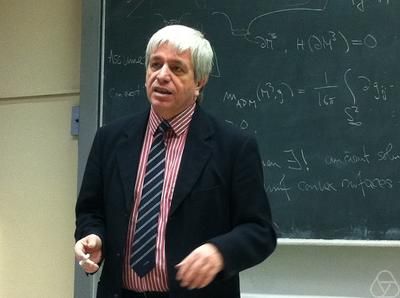
Gerhard Huisken
Director, Mathematische Forschungsinstitut Oberwolfach (MFO)
Professor, University of Tübingen
Biography
Dr. Gerhard Huisken received his PhD from University of Heidelberg in 1983. He was a Postdoctoral Fellow at the Australian National University in Canberra and completed his Habilitation at University of Heidelberg in 1986. He was on faculty at the Australian National University in Canberra from 1986-1992, before becoming a Professor at the University of Tübingen from 1992-2002, where he served as the Dean of Faculty of Mathematics from 1996-1998.
From 2002-2013, Dr. Huisken served as a Director at the Max Planck Institut für Gravitational Physics. Since 2013, he has been the Director of the Mathematische Forschungsinstitut Oberwolfach (MFO) and Professor at the University of Tübingen. He was a Visiting Professor at University of California San Diego in 1986 and at Princeton University from 1990-2000.
Dr. Huiskin is known for foundational contributions to the geometric flows, especially the mean curvature flow, where Huisken's monotonicity formula is named after him. With Dr. Tom Ilmanen, he proved a version of the Riemannian Penrose inequality by using the inverse mean curvature flow.
Dr. Huisken received various honors, including the Medal of the Australian Mathematical Society (1991), Leibniz Prize (2003), Cantor-Medal of the German Mathematical Society (2026). He is a Fellow of the Heidelberg Academy for Sciences and Humanities, the Berlin-Brandenburg Academy of Sciences and Humanities, the German Academy of Sciences Leopoldina, the American Mathematical Society and the Academia Europaea.
Lectures
Monday, November 2, 2026
Lecture I (Public Lecture)
Geometry and Analysis describing Gravity
Lewis Lab 270; 7:30 PM; Lobby Reception at 6:45 PM [Subject to Change]
Wednesday, November 4, 2026
Lecture II
Geometric Evolution Equations
Chandler-Ullmann (CU) 218; 4:30 PM; Tea Time at 4:00 PM (CU 212)
Friday, November 6, 2026
Lecture III (joint with Lehigh Geometry & Topology Conference)
Sweeping Out Asymptotically Flat 3-manifolds by Mean Curvature Flow
Rauch Business Center (RB)184; 1:30 PM
Abstracts
Lecture 1
Title: "Geometry and Analysis describing Gravity"
Abstract: Since ancient times geometric concepts have been used to model astronomical phenomena such as the motion of the planets. In modern times geometry has merged with analysis to provide accurate models of gravitational phenomena involving stars and their planets, black holes and gravitational waves in the context of General Relativity - with the new mathematical insights leading also to progress in the understanding of many other phenomena surrounding us. The lecture describes in a non-technical way how ancient geometric concepts such as the isoperimetric inequality as well as classical concepts from Newtonian physics reappear in the curved space-times of General Relativity
Lecture 2
Title: "Geometric Evolution Equations"
Abstract: The lecture describes the deformation of hypersurfaces in normal direction with a speed depending on the curvature of the surface at the given point and and time. This leads to non-linear systems of partial differential equations of parabolic type that have a smoothing effect similar to the heat equation for a short time while allowing the development of singularities for larger times that in some cases can be overcome by surgery methods. We describe the geometric structure of solutions and the analytical techniques needed for their study.
Lecture 3
Title: "Sweeping out asymptotically flat 3-manifolds by mean curvature flow"
Abstract: Asymptotically flat 3-manifolds appear as space-like time-slices of Lorentzian 4-manifolds in the description of isolated gravitating systems. We describe recent joint work with C. Sienstrari on the construction of ancient solutions of mean curvature flow that sweep out the entire region between spatial infinity and the outermost horizons of black holes in the system, providing a natural geometric radial coordinate. The results rely on new priori estimates for ancient solutions in the asymptotically flat setting.