On the False Discovery Rate of the Benjamini–Hochberg Procedure in Two-Sided Gaussian Mean Testing Under Dependence
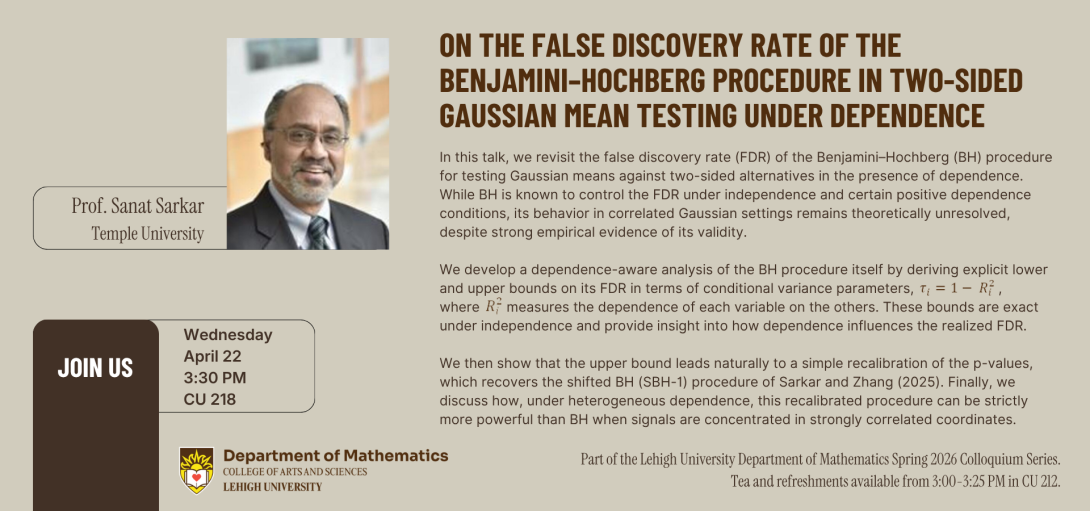
Dr. Sanat Sarkar, Temple University
Abstract: In this talk, we revisit the false discovery rate (FDR) of the Benjamini–Hochberg (BH) procedure for testing Gaussian means against two-sided alternatives in the presence of dependence. While BH is known to control the FDR under independence and certain positive dependence conditions, its behavior in correlated Gaussian settings remains theoretically unresolved, despite strong empirical evidence of its validity.
We develop a dependence-aware analysis of the BH procedure itself by deriving explicit lower and upper bounds on its FDR in terms of conditional variance parameters, Ti=1 - Ri2, where Ri2 measures the dependence of each variable on the others. These bounds are exact under independence and provide insight into how dependence influences the realized FDR.
We then show that the upper bound leads naturally to a simple recalibration of the p-values, which recovers the shifted BH (SBH-1) procedure of Sarkar and Zhang (2025). Finally, we discuss how, under heterogeneous dependence, this recalibrated procedure can be strictly more powerful than BH when signals are concentrated in strongly correlated coordinates.
Tea and refreshments available from 3:00-3:25 p.m. in the Assmus Conference Room (CU 212).